


The Dance of Light and Moss: Autumn Photography at Caddo Lake


For more than half a decade, I've made the pilgrimage south each fall, spending weeks immersed in the swamps of Caddo Lake. There, amid mist-shrouded bald cypress and golden Spanish moss, I chase the final movement of a seasonal symphony I’ve been following since the Arctic Circle. These autumnal displays in the far southern reaches of the continental U.S.—within one of the world’s largest flooded cypress forests—mark both an end and a beginning: the closing notes of fall’s long crescendo and the culmination of a photographic journey I call Colors of Caddo.
Autumn transforms Caddo Lake into one of the most enchanting landscapes in North America. Bald cypress trees glow in shades of copper and orange, their reflections doubled across still waters. Spanish moss drapes in golden light, swaying gently with the breeze, as mist hovers in the early morning. For photographers, autumn at Caddo Lake is not just a season—it is a fleeting window where atmosphere, color, and texture merge into pure artistry. This popularity is clear in recent years by the sheer number of photographers flocking to the lake—its channels suddenly overflowing with Gore-Tex and nylon, as if a rainstorm of REI, Patagonia, North Face, and Columbia shells had been scattered among the mist and cypress knees.
Caddo Lake Photography: Capturing Autumn’s Fiery Color Palette

Each year I arrive with the same anticipation, and each year Caddo Lake presents a new palette. Early in the season, hints of lingering green contrast against the first blush of orange, as if summer isn’t quite ready to let go. By peak autumn, the entire swamp seems aflame—fiery copper canopies mirrored in dark water until you can hardly tell where the trees end and their reflections begin. And then, late in the season, muted tones return, leaving a subdued, painterly calm that emphasizes the sculptural forms of trunks and knees.
For photographers, this cycle offers endless opportunities. Adjusting white balance to lean warm will accentuate the richness of autumn hues, while cooler tones emphasize contrast between fire and shadow. It’s less about recording a literal scene and more about translating the feeling of standing inside a cathedral of trees at their brightest hymn.
Backlight and the Glow of Spanish Moss

If the cypress foliage is the symphony’s crescendo, Spanish moss is the violin section—delicate, layered, and utterly transformative when the light catches it. Backlighting here is magical. At dawn and dusk, when the sun’s angle is still low, each strand of moss glows as though spun from gold.

The trick is in positioning. As we move through the groves, our captain and I work to guide the boat with subtle shifts, placing clients in just the right spot to catch the sun filtering through branches and igniting the moss against the shaded backdrop. Slight underexposure will protect your highlights and deepen the mood, while a telephoto lens can compress the canopy into luminous layers. The result is less documentary and more ethereal—exactly the kind of artistry that keeps photographers returning to Caddo Lake autumn after autumn.
Composing in Complexity
Photographing Caddo Lake in autumn is like trying to compose inside a living labyrinth. Cypress trunks rise in endless repetition, moss dangles in textured veils, reflections double the density, and cypress knees break the surface like punctuation marks in an otherwise flowing sentence. At first glance, it can feel overwhelming—where does one begin? But with patience, the complexity becomes your palette.
Reflections as Canvases: On calm mornings or evenings, the water mirrors the fiery canopy so perfectly that the scene feels doubled—sky above and sky below. When a breeze passes, ripples transform that mirror into brushstrokes, shifting the mood from sharp realism to soft impressionism. Deciding which to highlight is less about rules and more about listening to the story you want the frame to tell.

Sony A1 | Tamron 50-400mm | f/13 | 1/1000 | ISO 2500 Negative Space for Breathing Room: Amid so much visual density, open water becomes as valuable as subject matter. Leaving patches of empty surface in your frame allows the eye to rest and keeps the scene from feeling suffocating. This space often amplifies the strength of the trunks and the glow of foliage by contrast.

Selective Focus for Mood: Shallow depth of field can turn chaotic layers into atmosphere. A single glowing branch or strand of moss becomes the lead character, while the rest of the forest fades into soft supporting texture. This is especially effective in autumn when warm color and cool shadow play against each other.

Sony A1 | Tamron 50-400mm | f/7.1 | 1/800 | ISO 800 Small Scenes Within the Grandeur: While the big cathedral-like vistas of Caddo are tempting, slowing down to notice the intimate details often yields the most memorable images. A cluster of leaves glowing like embers, knees catching misty light, or a single tree framed cleanly in reflection can carry as much emotional weight as the sweeping panoramas. These small scenes bring balance to a portfolio and remind viewers of the layered beauty hidden within the whole.

Sony A1 | Tamron 50-400mm | f/6.3 | 1/200 | ISO 2500 Compression to Simplify Chaos: Longer focal lengths are invaluable here. A telephoto lens compresses layers of trees, flattening distance into painterly patterns of trunks, color, and moss. This technique lets you isolate rhythm and repetition, creating a sense of design in what otherwise feels chaotic. The forest becomes a tapestry instead of a tangle.

Compression and lighting can also create framing opportunities that help guide a viewer deeper into the scene.
The secret is embracing complexity without letting it overwhelm. By shifting perspective—zooming in, compressing space, carving out breathing room, or focusing on reflection—you move from chaos to composition. In autumn, when light and color are at their peak, these decisions shape not just an image, but the emotional resonance of the scene.
Why Autumn at Caddo Feels Like a Painting

Drifting through the swamp in autumn, it’s easy to feel as though you’ve stepped inside an impressionist canvas. The repeating verticals of cypress trunks echo the deliberate strokes of a painter’s brush, while layers of fog soften the scene like a wash of glaze. The forest becomes less a collection of trees and more a composition in light, shadow, and color.
Patterns as Brushstrokes: The endless rhythm of trunks and knees provides structure, much like the underdrawing of a painting. When compressed through a telephoto lens, these lines overlap into a dense tapestry, creating geometric strength that balances the wildness of hanging moss and drifting reflections.
Layers of Atmosphere: Autumn mornings bring mist that veils the forest in soft gradients. These natural layers add depth and mystery, encouraging photographers to think like painters—working in background, middle ground, and foreground to create dimensional images.

Sony A1 | Tamron 50-300mm | f/9 | 1/500 | ISO 1250 Color as Emotion: The copper and orange foliage set against cool water and shaded trunks delivers a palette that is both dramatic and harmonious. Photographers can lean into these natural contrasts, using color not just to describe the scene but to convey the mood of the bayou at its fiery peak.
Experimenting with Painterly Techniques:
Intentional Camera Movement (ICM): Blurring the strong verticals of cypress into fluid strokes of color, echoing the gestures of impressionism.
Long Exposures: Smoothing water ripples until they become abstract washes of tone.
Post-Processing Choices: Subtle adjustments in color grading or tonal contrast that echo the way painters interpret a subject rather than simply reproduce it.
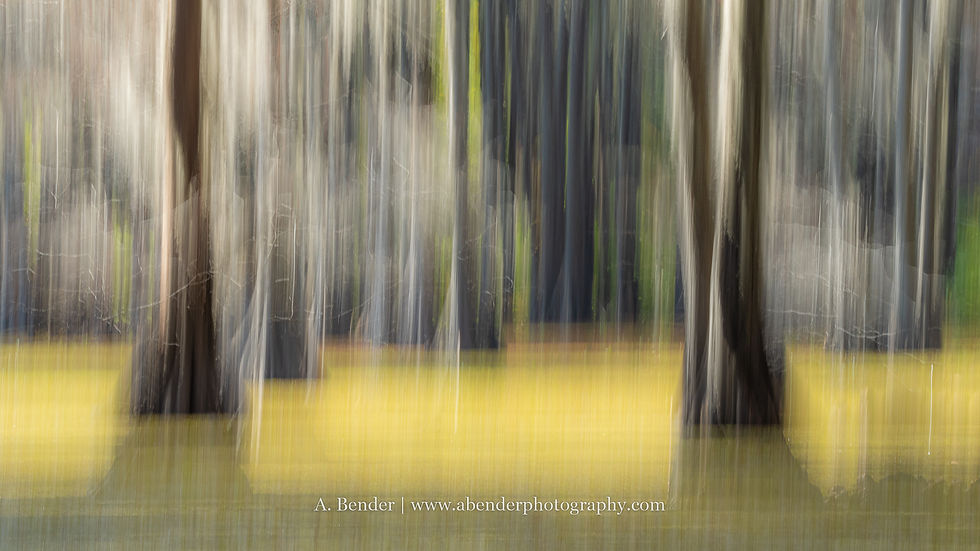
Use of vertical ICM to capture a stand of cypress in mid-afternoon light. Details as Still Lifes: Even the small elements—strands of moss catching backlight, a patch of knees glowing like embers, or leaves drifting across mirrored water—feel like subjects that could be painted on their own. They remind us that art often lies in the overlooked corners of a landscape.

"Still Water Depth" Not every autumn image needs to burn with color. It is a season of transition - of aging; of falling.
In autumn, the bayou doesn’t just present itself as a place to photograph—it offers itself as a living canvas. Each frame is less about literal documentation and more about interpretation, inviting us to translate what it feels like to be here rather than what it looks like. This is where Caddo Lake photography transcends craft and enters the realm of art.
A Place Worth Protecting

It’s easy to be swept away by the artistry of Caddo Lake photography, but this bayou is more than a backdrop—it’s a fragile ecosystem that needs our care. As one of the largest flooded cypress forests in the United States, the lake faces real challenges: invasive species creeping through its channels, shifting water management policies, and the constant pressure of human activity. Every paddler, fisherman, and photographer who visits leaves an imprint, which makes responsible practices essential.
When visiting, tread lightly. Avoid stepping on cypress knees, which are as delicate as they are iconic. Resist the urge to disturb sediments or drag equipment into sensitive areas. Pack out every scrap, no matter how small, and respect the quiet rhythm of the forest. These small choices, multiplied by every visitor, protect the integrity of a landscape that has already endured for centuries.

Equally important is ensuring your tour leader is properly permitted. This not only ensures that you’re with someone who knows the water, safety protocols, and photography opportunities, but it also means that the operators guiding you are contributing responsibly to the stewardship of the lake. Permitting helps regulate traffic, ensures local compliance, and sustains conservation funding—so the very experiences photographers treasure here can continue for generations.
Ultimately, protecting Caddo Lake is about reciprocity. We take inspiration and images, but we owe respect and responsibility in return.
Closing Reflection

Breathing in the cool, moss-scented air, I sit still in the boat with my camera at rest, watching the dance of light and moss unfold across the bayou. Each autumn, Caddo Lake reminds me that photography here is about more than capturing images—it’s about slowing down, learning to see atmosphere as much as subject, and allowing the rhythm of the swamp to shape your vision.
For those who long to experience this magic firsthand, I invite you to join me and fellow photographer Gary Randall on our annual Colors of Caddo Workshop. Over several days, we’ll explore this flooded forest at its peak of autumn color, studying how light transforms moss and water into living canvases, and practicing both grand landscapes and intimate scenes. More than a workshop, it’s an immersion in a place where artistry, ecology, and conservation meet—and a chance to create images that carry the spirit of Caddo long after the season fades.
For those interested in seeing more images I have created during my time on Caddo, make sure to check out my Colors of Caddo Collection.


Comments